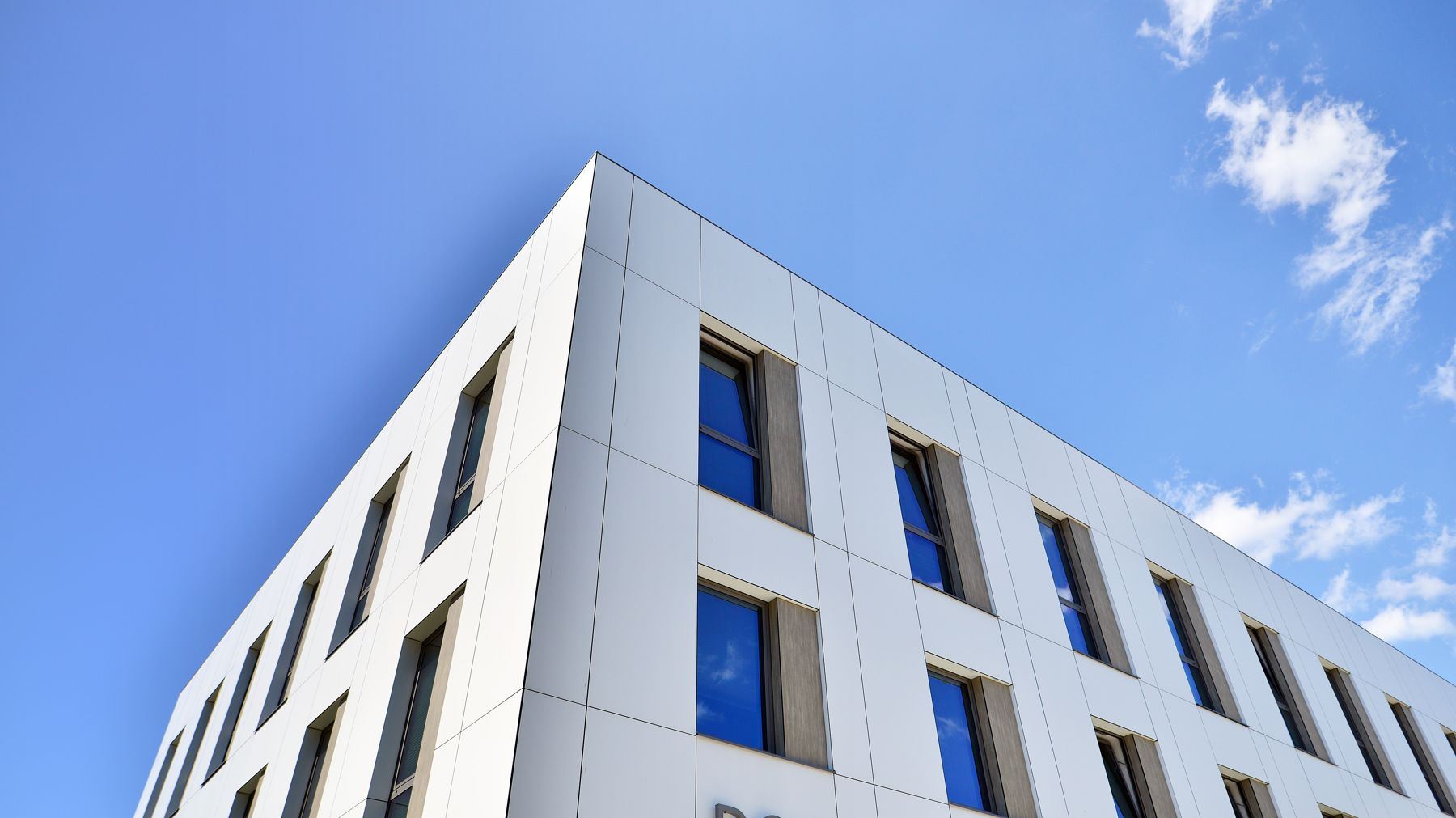
Choosing the cladding material sets the look, the fire strategy and the long-term maintenance of a building. In South Florida, sun, salt air and hurricane winds add their own demands. This guide compares the three materials we specify most.
ACP: aluminum composite panels
ACP is two thin aluminum skins bonded to a fire-retardant (FR) or non-combustible (A2) mineral core. It gives large flat panels, crisp routed corners and a wide color range at a competitive cost. Polyethylene-core panels are not appropriate for building facades and are not used on our projects.
Solid aluminum plate
A single 2 to 3 mm aluminum sheet, folded and stiffened. It has no core, so it is non-combustible, and it can be curved, perforated and folded into deep returns. It is the premium choice for signature and coastal architecture.
Compact HPL
High-pressure laminate panels with a UV-resistant decorative surface in wood, stone or solid colors. Installed as a ventilated rainscreen, HPL keeps the wall dry and cooler, with very low maintenance.
Fire performance and NFPA 285
Exterior wall assemblies that include combustible components typically must pass NFPA 285 on buildings over 40 ft. The test applies to the complete assembly, not just the panel, so the panel, insulation, barrier and framing are specified together.
Durability in sun and salt air
For metal panels, specify a coating to AAMA 2605, the highest architectural standard, which includes 10 years of South Florida exposure testing. For HPL, choose exterior grades with the manufacturer's color warranty. Use isolated, corrosion-resistant fixings near the coast.
Which one should you choose?
Choose ACP for large flat areas at a competitive cost, solid aluminum for curves, perforation and coastal signature facades, and HPL for warm, natural looks. Many of the best buildings combine two of them.
Frequently asked questions
Which cladding is non-combustible?
Solid aluminum plate is non-combustible. ACP with an A2 core has limited combustibility. FR-core ACP and fire-retardant HPL are used in tested assemblies that meet the code.
Which cladding needs the least maintenance?
All three need only periodic washing when specified correctly. HPL needs no painting; metal panels with AAMA 2605 coatings hold color for many years.
Code references are summarized for orientation. Final requirements are confirmed by the engineer of record and the building department for each project.